
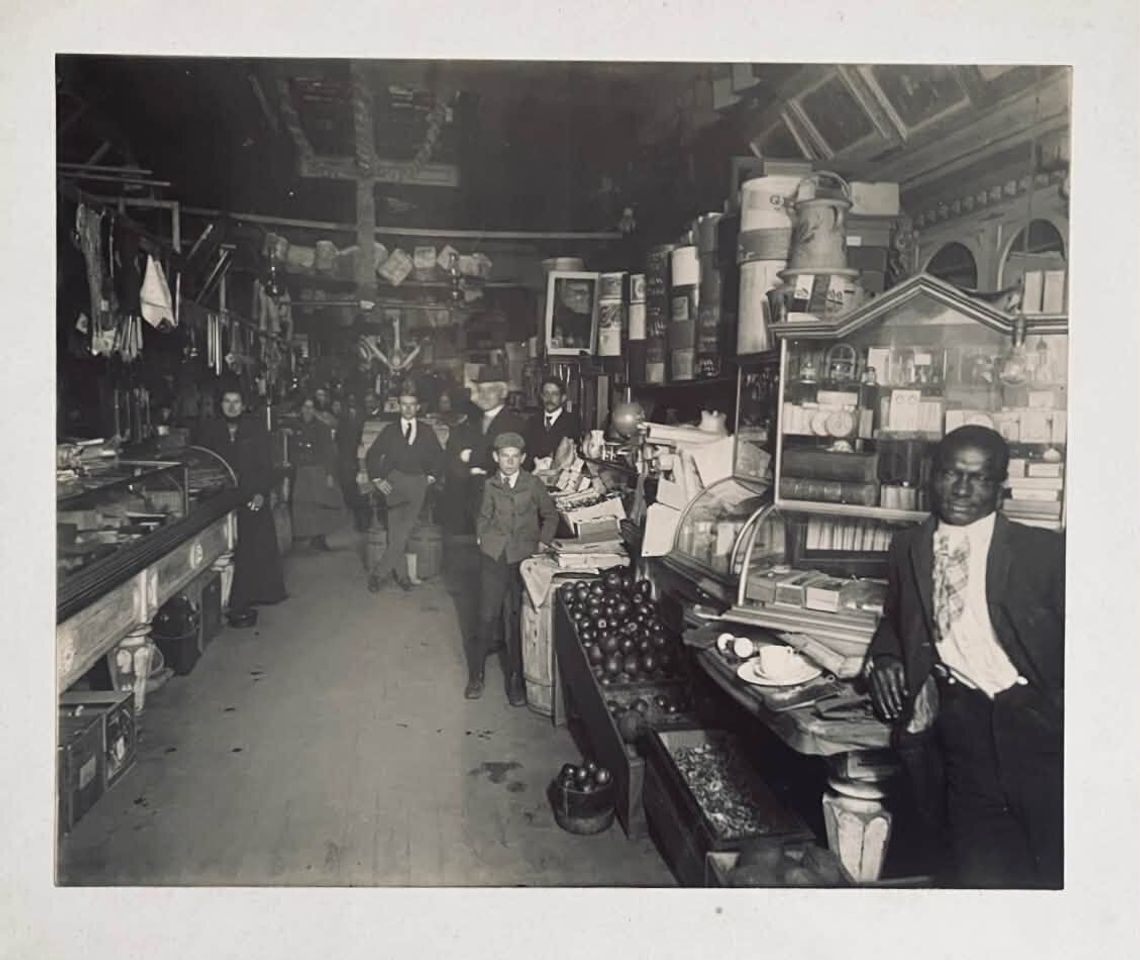
Courtesy of the Canton-Madison County Historical Society
Recently, the Canton–Madison County Historical Society was contacted by Mrs. Sarah Caudell of Clearwater, Florida, who reached out with an original photograph and historical materials connected to one of Canton’s early merchants, Henry Gwinner.
Here is the special story behind how these materials came into Mrs. Caudell’s care.
After Henry Gwinner’s granddaughter, known as “Muggee” Lutz, and her husband, Clovis Lutz, moved to Clearwater, Florida, they became good friends with Mrs. Caudell.
Knowing of Mrs. Caudell’s love of history, the Lutzes gave her an original photograph of the interior of Henry Gwinner’s store in Canton, along with information about the family and business.
Mrs. Caudell carefully preserved these pieces of Canton history. Many years later, she remembered where their story began and reached out to share them with the CMCHS.
The photograph she preserved is remarkable.
The interior view allows us to step inside Gwinner’s store. The long, narrow establishment is crowded with merchandise. Glass cases and counters line the room, shelves rise toward the ceiling, and goods occupy nearly every available space. Produce, barrels, packaged goods and household merchandise can be seen throughout, while a number of people stand among the counters and displays.
The photograph itself has its own history. Written on the back of its mount are the words “H. Gwinner’s Store” and “Picture taken 1869 in Canton, Miss.” Another surviving marking identifies Weatherford & Swan, Photographers, Canton, Miss.
If the handwritten date accurately records when the photograph was taken, it provides an extraordinarily early view of Gwinner’s Canton business, during the period of Reconstruction only a few years after the Civil War.
After receiving Mrs. Caudell’s photograph, we were also able to pair it with an exterior image familiar to the CMCHS: a view of Gwinner’s storefront published curated for the Society’s 2004 pictorial history of Canton.
To the best of our research, Gwinner’s store was located on the north side of the Canton Square.
The exterior photograph brings the business to life from another perspective with Mr. Henry Gwinner standing out front with another unidentified man. Produce fills open bins and crates along the sidewalk, merchandise and advertisements surround the entrance, and two men stand amid the displays. And Gwinner’s apparently offered Cantonians more than groceries and household goods.
An April 14, 1877 notice in Canton’s American Citizen announced that the “Little Giant” Soda Fountain was in operation for the season “AT GWINNERS.”
For five cents, customers could purchase a large glass of soda, advertised with the wonderfully Reconstruction-era phrase “the spirit of ’76.” The notice praised the machine as a “model of beauty” and said it offered advantages “just suited for the times and seasons.”
These surviving pieces - the photograph preserved by the Gwinner family and Mrs. Caudell, the exterior image preserved by the CMCHS, the photographer’s imprint, the handwritten identification, and the 1877 newspaper notice - begin to reconstruct the story of a business that was once part of daily life on the Canton Square.
Henry Gwinner himself was eventually laid to rest here in Canton, where his grave marker survives today.
But the merchant is only half of the story.
Before Henry Gwinner became a Canton businessman, his life had taken a very different course during the Civil War. His surviving military records tell of his work as a saddle maker, his service with Mississippi cavalry, his appointment as a bugler, and an unusual wartime assignment seeking the services of an “honest practical mechanic.”
And the connection between the Gwinner family and the Canton Square did not end with Henry.
Something donated to Canton by Clovis Lutz remains on the Square to this very day.
Before coming to Canton, Henry Gwinner served during the Civil War.
Family research preserved with the collection identifies him as a private in Company I, 28th Regiment, Mississippi Volunteer Cavalry. The records indicate that he enlisted in 1862 and was appointed Chief Bugler on July 1 of that year.
He later appears as an acting brigade bugler and among staff and acting staff associated with Jackson’s Cavalry Division.
One particularly interesting record dates to February 1, 1864.
Correspondence from the Office of the Chief Inspector of Field Transportation requested that Gwinner be assigned to special service. The reason was his civilian trade: Henry Gwinner was a saddle maker.
The correspondence described him as thoroughly acquainted with the work required and emphasized the need for an “honest practical mechanic.”
Subsequent records place Gwinner on detached service at Demopolis, Alabama, where he served as a foreman.
His military story continued through the closing days of the war. Family research records Gwinner on a prisoner-of-war roll following the surrender of Confederate forces at Citronelle,Alabama, in May 1865, followed by his parole.
Another record places him on a prisoner roll at Grenada, Mississippi, later that month.
Four decades later, Gwinner told part of the story in his own hand.
On April 26, 1905, while residing in Canton, he completed a Certificate of Eligibility for a Confederate Cross of Honor for the United Daughters of the Confederacy. Gwinner recalled entering Confederate service as a private and identified his final position as Chief Bugler, Armstrong’s Brigade.
And at the bottom of the document appears something particularly personal:
Henry Gwinner’s own signature.
As is often the case with historical records created at different times, there are some discrepancies among the surviving documents concerning dates and details of his service.
Rather than diminishing their value, these differences remind us why preserving the original records, and comparing them carefully is so important.
The papers shared with us also provide a glimpse into how Henry Gwinner’s story survived long after his death.
Among them is a handwritten note dated March 28, 1980, accompanying research into Gwinner’s military service. It reads in part:
“Here is Grandfather Henry Gwinner’s record … Lee wanted you to have.”
Another notation asks that the material, once read, be “pass[ed] on to Aunt Muggie.”
That “Muggie” was Henry Gwinner’s granddaughter, Edythe Hollingsworth Lutz (1899–1993), remembered by the family as “Muggee.” She was married to Clovis Charles Lutz (1897–1983). Both Edythe and Clovis were buried here in Canton.
Eventually, Muggee and Clovis moved to Clearwater, Florida, where they became friends with Sarah Caudell. Knowing Mrs. Caudell’s love of history, they entrusted her with the original photograph of Gwinner’s Canton store and the history associated with the family.
Through her generosity, materials that had traveled through the Gwinner family and eventually hundreds of miles away have now been shared with the community where so much of the story took place.
But there is one final twist.
Not everything the Lutz family left behind ever left Canton.
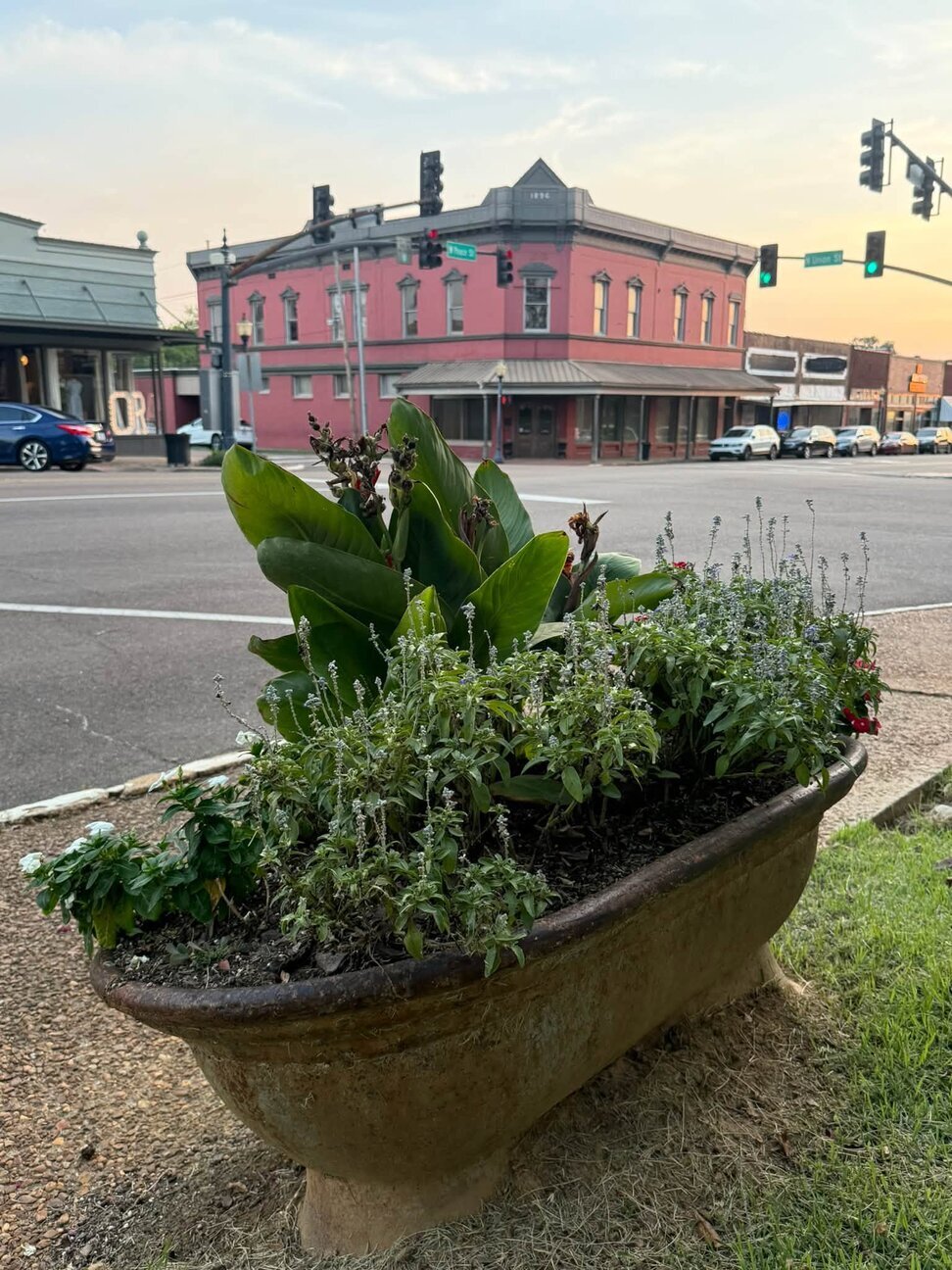
Clovis Lutz donated a watering trough to the City of Canton.
Remarkably, it is still on the Courthouse Square today.
Its purpose has changed with the times. The old trough is now filled with flowers and serves as a planter, maintained by the Canton Garden Club. Generations of Canton residents have passed it—many perhaps never knowing the family story behind this familiar object.
More than a century after Henry Gwinner conducted business in downtown Canton, this familiar object provides a tangible connection between his descendants and the community their family once called home.
The Canton–Madison County Historical Society extends its sincere appreciation to Mrs. Sarah Caudell of Clearwater, Florida, for preserving these materials and for recognizing that their story belonged back in Canton.
all photos Special to The Canton News
Comment
Comments